Football results are among the most frequently searched pieces of sports information online. A final score may look simple, but it often tells only a small part of the story. Behind every result are statistics, tactical decisions, player performances, injuries, and match situations that can help fans understand why the game developed in a particular way.
For people who follow leagues regularly, learning how to interpret results can make football analysis more meaningful. Instead of focusing only on whether a team won or lost, it is useful to examine the broader context surrounding each fixture.
Why football results matter
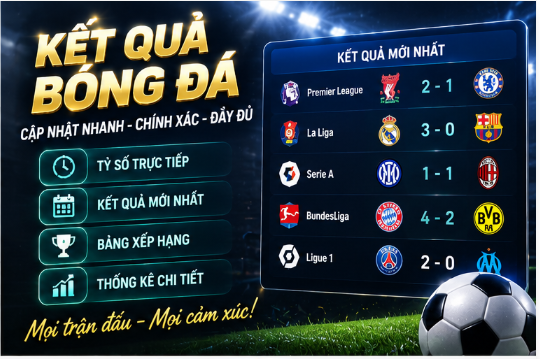
The Kết quả bóng đá section can be used as a starting point for checking completed matches and reviewing the latest scores.
Results help fans track how teams are progressing throughout a competition. They also show whether a club is maintaining momentum, struggling for consistency, or improving after a difficult period.
However, a single match should rarely be used to define a team’s true level. Football contains many unpredictable elements, and even strong teams can lose unexpectedly.
Looking at several fixtures together gives a more reliable picture.
The final score is only the beginning

A 2-0 result may suggest that one team dominated, but that is not always the case.
Sometimes a team scores early, defends deeply, and allows the opponent to control possession for the rest of the match.
In another game, a team may create many chances but fail to score because of poor finishing or excellent goalkeeping.
For this reason, the final score should be combined with other statistics such as shots, shots on target, possession, corners, and expected goals when available.
These indicators provide additional context.
Reviewing recent form

Recent results are commonly used to evaluate team form.
A sequence such as four wins and one draw may indicate strong momentum. However, the quality of the opponents matters.
Winning several matches against lower-ranked teams may not provide the same evidence as performing well against title contenders.
The location of each match is also important. Some clubs are significantly stronger at home, while others perform consistently in away fixtures.
Fans should therefore examine results in context rather than simply counting wins.
Goals scored and conceded
Scoring patterns can reveal useful information about a team’s playing style.
A club that scores regularly may possess strong attacking options, but the distribution of goals is worth examining.
If almost every goal comes from one striker, the team may become less dangerous if that player is injured or suspended.
Defensive numbers are equally important.
A team that concedes very few goals may have strong organization, a reliable goalkeeper, or a more cautious tactical approach.
Comparing both attacking and defensive data gives a better overall picture.
Head-to-head results
Previous meetings between two teams are often reviewed before a new fixture.
Head-to-head information can reveal recurring tactical patterns or show whether one team has historically struggled against another.
However, older results should be treated carefully.
Managers, players, formations, and overall team quality can change significantly over time.
A match played four years ago may have limited relevance to the current squads.
Recent meetings are usually more useful, especially when the same core players and coaching structures remain in place.
Understanding competition context
Not every football match carries the same level of importance.
A league fixture, cup tie, friendly, and knockout match can create very different tactical approaches.
In a two-leg competition, for example, a team that already has a large advantage from the first match may play more defensively in the return leg.
Similarly, a club that needs only one point to qualify may prioritize caution rather than attacking football.
Match context is therefore essential when interpreting results.
Using kèo nhà cái as an additional reference
Fans can also explore broader football information through kèo nhà cái when comparing results with schedules, odds, and other match-related data.
Combining different sources can provide a more complete picture of how teams are performing.
However, no single statistic should be treated as a guaranteed predictor.
Results describe what has already happened. They cannot guarantee what will happen in the next match.
Football remains unpredictable even when one team appears stronger on paper.
Red cards and major match events
Some results are heavily influenced by specific incidents.
A red card in the first half can completely change the tactical balance of a match.
Penalties, injuries, controversial decisions, or an early goal can also affect how teams approach the rest of the game.
When reviewing a surprising result, it is therefore useful to check the timeline.
A simple final score may not reveal that one side played most of the match with ten players.
Understanding these events prevents misleading conclusions.
Comparing home and away performance
Many teams show a significant difference between home and away form.
Home advantage may come from crowd support, familiarity with the stadium, travel conditions, or tactical confidence.
A team might have an excellent overall record but struggle consistently away from home.
Separating home and away results can therefore improve analysis.
It is also useful when comparing teams that appear similar in the league table but perform very differently depending on venue.
Read More: Match Schedule Today: Latest Football Fixtures and Game Times
Avoid treating results as guaranteed predictions
Past results can help identify trends, but they should never be viewed as certain forecasts.
A team that has won five consecutive matches can still lose its next game.
Injuries, rotation, fatigue, tactical changes, and random events may alter the outcome.
Anyone using football results in connection with betting should remember that financial risk is always present.
Predictions cannot remove uncertainty.
Only money that can be comfortably lost should ever be considered for betting activity.
Conclusion
Football results provide much more information than a simple win, draw, or loss. When interpreted properly, they can reveal patterns in form, attacking strength, defensive organization, home performance, and tactical behavior.
The most effective approach is to combine final scores with match statistics, recent form, team news, and competition context.
Fans should also remember that historical data cannot guarantee future outcomes.
By viewing football results as one part of a wider analytical process, readers can develop a more balanced and informed understanding of teams, competitions, and individual matches.
Read more related blogs on Bio4Insta. Also Join WhatsApp Group for more updates.