Modern football generates an enormous amount of data every day. From domestic leagues to international competitions, fans often need reliable aggregation sources to keep track of scores, fixtures, and statistics. Content associated with KQBD is commonly searched by users who want to quickly stay updated with the latest football results.
A useful KQBD source does more than simply display the final score. When interpreted properly, match results can be combined with statistics to provide a deeper understanding of how a game actually unfolded.
Results Are the Starting Point
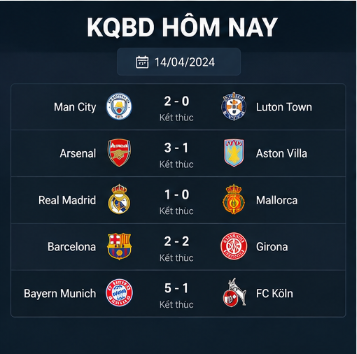
The final score answers the most basic question: which team won?
However, it does not always tell the complete story of the match.
A team may win 1-0 even though its opponent created significantly more scoring opportunities. Conversely, a team that dominates possession and produces more shots can still end up losing.
For this reason, the score should be viewed as the starting point of match analysis rather than the entire story.
Check the Match Time and Status

When following football results online, users should distinguish between matches that have finished and those that are still in progress.
A 1-0 scoreline in the 60th minute is not yet a final result.
Some platforms use abbreviations such as HT for half-time, FT for full-time, and ET for extra time.
Understanding these abbreviations helps prevent confusion when reading live match information.
It is also important to pay attention to update times, especially when an internet connection or data provider experiences delays.
Shots Help Explain the Flow of the Match
image
The number of shots is one of the most commonly used football statistics.
If one team records significantly more attempts, it may indicate that they were more proactive in attack.
However, quantity does not necessarily reflect quality.
Fifteen long-range attempts may be less dangerous than four clear opportunities created inside the penalty area.
Therefore, shots on target and the locations from which attempts are made are also worth considering.
Possession Is Not Everything

Possession statistics can easily create a strong impression about how a match was played.
A team with 65% possession is often assumed to have controlled the game.
However, some teams deliberately allow their opponents to have more of the ball so they can focus on counterattacking.
They may have only 35% possession while still creating more dangerous opportunities.
Possession should therefore always be interpreted within the tactical context of the match.
What Do Corner Statistics Tell Us?
The number of corners can provide some indication of attacking pressure.
Teams that frequently move the ball into wide areas or deliver crosses into the penalty box often generate more corners.
However, having more corners does not automatically mean having better goalscoring opportunities.
A team could take 10 corners and still fail to score.
For that reason, corner statistics should be considered alongside other match indicators rather than analyzed in isolation.
Cards and Match Developments
Yellow and red cards can have a major influence on how a match develops.
A red card early in the second half, for example, may force a team to completely change its tactical approach.
Therefore, if the scoreline or statistics change dramatically after a particular moment, it is useful to check the match events.
A significant personnel change can sometimes explain much of what happens during the remainder of the game.
Starting Lineups
Lineup information helps viewers better understand a team’s tactical approach.
If several key players are rested, the team’s performance may be very different from what was seen in its previous match.
The formation is also important.
A switch from a 4-3-3 formation to a system featuring three central defenders can change how a team controls midfield areas and builds its attacks.
Starting lineups are therefore valuable information to examine alongside KQBD data.
Read More: Football Standings Today: Updated Tables and Team Positions
Compare Results With Recent Form
A single result can sometimes be misleading.
To properly evaluate form, readers should examine a sequence of matches rather than focusing on just one game.
However, simply counting wins and losses is not enough.
The quality of the opposition and whether matches were played at home or away should also be considered.
A team that has recorded several consecutive victories against weaker opponents is not necessarily performing better than another team that has recently faced a very difficult schedule.
Head-to-Head Records Have Their Limitations
Head-to-head statistics can be interesting, but they need to be interpreted carefully.
If two teams have faced each other several times recently, the data may reveal certain tactical patterns or recurring trends.
However, matches played many years ago may have limited relevance today.
Managers, players, formations, and overall playing styles may all have changed considerably.
Current information is generally more valuable than results from the distant past.
Check Multiple Sources When Necessary
Live football data can sometimes be delayed or differ between providers.
The same match situation may also be classified differently depending on the data source.
If certain information is particularly important, users should consider checking the official website of the competition or club as an additional reference.
This is especially useful when confirming fixture changes, starting lineups, suspensions, or other official updates.
Relying entirely on a single source may not always provide the most complete picture.
Results Do Not Guarantee the Future
KQBD represents data about events that have already happened.
This information can help users identify patterns, trends, and recent form.
However, past results do not guarantee that the next match will unfold in the same way.
Football contains numerous unpredictable variables, including injuries, red cards, individual mistakes, tactical adjustments, and unexpected changes during a match.
This uncertainty is one of the reasons football remains such an unpredictable sport.
How to Use Football Data Effectively
Viewers should combine several layers of information when analyzing a match.
Start with the scoreline, then examine shots, possession, cards, lineups, and the overall context of the game.
When evaluating a team’s form, look at several matches rather than relying on a single result.
This approach can provide a more balanced and comprehensive understanding of team performance.
Football data is most valuable when it is interpreted within the appropriate context.
Conclusion
KQBD helps football fans stay updated with scores and follow match developments more conveniently. However, the final result represents only one part of the overall picture.
By combining the scoreline with shots, possession, starting lineups, disciplinary cards, and recent form, viewers can gain a clearer understanding of why a match unfolded the way it did.
Most importantly, historical data should be used for analysis and reference rather than treated as certainty about what will happen in future matches.
Read more related blogs on Bio4Insta. Also Join WhatsApp Group for more updates.